Why South Jakarta Spaces Need a Specific Approach to Room Acoustics
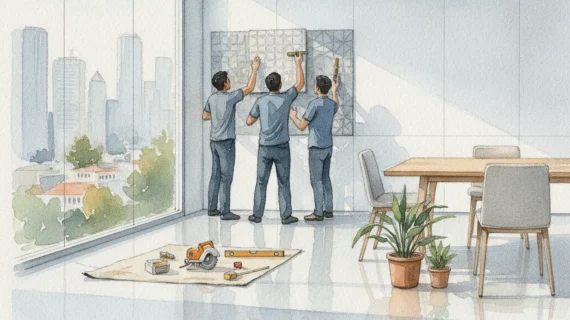
South Jakarta’s commercial and office districts are dominated by modern buildings clad in glass, concrete, and thin gypsum board. Those hard surfaces reflect sound aggressively, driving reverberation levels well above what any working environment needs. Our team, based in Pamulang, provides measured acoustic analysis and installs sound-absorbing panels sized and placed to match both the acoustic requirements and the aesthetic of each space.
Areas like TB Simatupang, Kuningan, and Kemang are packed with multi-storey office buildings featuring glass partitions and high ceilings. When walls and floors are mostly hard materials, sound bounces in every direction before it finally dies out. The result: conversation in a meeting room sounds layered and muddy, presentations lose clarity, and people end up speaking louder than they should.
Older colonial-style buildings and simple shophouses tell a different story. Rough plaster, timber, and carpet absorb a portion of reflected sound naturally. Modern buildings trade that acoustic benefit for the visual appeal of glass and exposed concrete, and nothing compensates for it unless acoustic treatment is added deliberately.
From a logistics standpoint, our workshop sits in Pamulang, Tangerang Selatan, which shares a direct border with South Jakarta. Travel time to TB Simatupang, Fatmawati, Cilandak, and Kemang is short, so our survey team can schedule site visits quickly without long lead times. It also means material delivery from the fabrication workshop to the project site stays efficient, with no need to cross the city.
What Is the Difference Between Room Acoustics and Soundproofing?
Room acoustics work focuses on controlling echo and speech clarity inside a space by adding absorbing materials such as acoustic panels and bass traps. Soundproofing focuses on blocking sound from travelling in or out of a space using heavy insulation. Understanding the difference keeps your budget aimed at the right problem.
Picture yourself in a meeting room where your voice sounds like you are speaking in a large bathroom. That is an acoustics problem, not a soundproofing problem. The fix is adding absorbing material, acoustic panels filled with acoustic wool, for example, which dampen reflected sound waves before they reach the next listener’s ears.
On the other hand, if sound from the meeting room one floor up carries clearly to the floor below, or street noise bleeds into a recording studio, that is an isolation problem. Solving it involves adding mass to walls, using dense materials such as layered hebel brick, and sealing every air gap that sound travels through. The technical approach is different, and so is the cost.
Confusing the two is very common and often leads to disappointment. Someone installs acoustic panels expecting outside noise to stop, only to find the problem unchanged. Before your site survey, it is worth reading about the difference between wall acoustic panels and bass traps to get a clearer picture of what each material actually does.
Room Types in South Jakarta That Most Often Need Acoustic Treatment
Based on the projects we have handled across this area, a handful of room types come up again and again with acoustic complaints.
Glass-Walled Meeting Rooms
This is the most common case in modern office buildings. Glass partitions that look clean and professional visually act as sound mirrors. Sound bounces back fast and creates a reverberation that makes it hard for participants to follow the conversation, especially when the room is used for video conferencing. Fabric-covered acoustic panels on lightweight frames are the solution we install most often in this type of space, because they mount without touching the existing wall structure.
Cafes, Lounges, and Restaurants
Cafe owners in Kemang or Cipete often describe the same problem: when the place fills up, guests have to shout to talk to the person sitting right across from them. Ceramic tile floors, exposed concrete ceilings, and bare brick walls send sound in every direction. Acoustic treatment in a commercial space like this needs to work with the venue’s look, not against it. If you manage a cafe or restaurant and recognize this problem, the page on acoustic treatment for cafes to make conversation comfortable covers the specifics in more detail.
Home Podcast and Music Studios
Many content creators and musicians in South Jakarta build small studios in a home or shophouse. Without proper acoustic treatment, recordings pick up room echo and sound unprofessional. For more serious music studios, from band rehearsal rooms to multi-track recording setups, the work is more involved and includes bass trap placement in room corners. The page on music studio acoustic contractors in Jakarta goes into the detail of that process.
Houses of Worship
Churches, mosques, and worship halls typically have high ceilings and large room volumes. A sermon or speech reverberates too long before it decays, so words overlap and become difficult to understand for anyone seated in the middle or back sections. Acoustic treatment in a house of worship is usually focused on improving speech intelligibility, not volume, by placing absorbing panels at the main reflection points.
How the Process Works, from Site Survey to Handover
Acoustic work that delivers verifiable results does not start by putting up material. It starts by understanding the room’s condition through measurement. Here is the workflow we follow:
- Initial Needs Discussion. Before the survey, we ask for basic information: room dimensions, primary function, and the specific problems you are experiencing. This can be done through a contact form or written message so the technical team can prepare the right measuring equipment.
- Site Survey and Measurement. The team visits your location to measure actual dimensions, identify surface materials, and take RT60 readings. RT60 is the reverberation time, the number of seconds it takes for sound to decay after the source stops. More detail on this process is available on the room acoustic measurement service page.
- Simulation and Panel Recommendation. Using the measurement data, we put together a recommendation covering the number, size, placement, and type of panels needed. At this stage we also discuss finishing options, fabric cover, color, and panel shape, if the space has specific aesthetic requirements.
- Fabrication at the Pamulang Workshop. Acoustic panels, bass traps, and padded acoustic wool are manufactured in-house at our workshop. Production typically takes 3 to 7 working days depending on quantity and design complexity. Because we build everything ourselves, specifications can be adjusted without waiting on third-party stock.
- On-Site Installation. The installation team arrives with finished panels ready to mount. Installation at South Jakarta locations generally completes in 1 to 3 days, depending on the room size and number of mounting points.
- Re-Measurement and Handover. Once all material is installed, we take a second RT60 measurement to confirm that reverberation has actually dropped. The measurement results become a technical document handed over alongside the completed project.
What Drives the Cost of Room Acoustic Treatment
No single price applies to every room, because every project starts from a different set of conditions. That said, a few key factors consistently shape the total cost:
| Factor | Effect on Cost |
|---|---|
| Room dimensions and volume | Larger rooms need more panels to reach the target RT60 value |
| Panel finishing choice | Standard fabric cover is more accessible in price; imported fabric or custom patterns add to production cost |
| Existing surface conditions | Rooms already lined with hard materials like glass or ceramic tile need more absorption points |
| Target RT60 value | A professional recording studio needs a lower RT60 than a standard meeting room, which means more material |
| Site access | High floors without a service lift, or narrow rooms, affect installation time and cost |
The quickest way to get a ballpark figure is to use the cost estimation calculator available on this site before moving to the survey stage. The number from the calculator is not a final quote, but it is enough to help you decide whether this project fits your current budget or whether it makes more sense to phase the work over time.
If budget is tight, we can also help you prioritize which part of the room to treat first so the improvement is felt most immediately, for example, starting with absorbing panels on parallel walls before adding bass traps in the corners in a later phase.
Frequently Asked Questions
How long does a room acoustics project take?
It depends on the size and complexity of the space. Custom panel fabrication at our Pamulang workshop typically takes 3 to 7 working days. On-site installation in South Jakarta usually wraps up in 1 to 3 days.
Is the initial consultation and site survey in South Jakarta chargeable?
For South Jakarta and the greater Jabodetabek area, we offer an initial site survey with flexible scheduling from our Pamulang office to measure room dimensions and reverberation levels directly.
Will acoustic panels damage the look of my interior?
No. The acoustic panels and padded wool we produce can be customized in color, fabric cover, and shape to match your office, cafe, or studio interior, so they work as a tidy decorative element as well.
Is egg-crate foam enough to fix echo in an office?
Standard egg-crate foam only absorbs certain high frequencies and performs poorly in the mid to low range. Office and meeting rooms need rigid-framed acoustic panels filled with measured-density acoustic wool insulation.
How do we know the acoustic treatment actually worked?
We re-measure the reverberation time (RT60) after all acoustic materials are installed to confirm the echo reduction is proven technically and speech clarity has improved.
Next Steps
If your South Jakarta space echoes, conversations overlap, or recordings fall short of the clarity you need, measured acoustic treatment is the answer. We have been handling all types of rooms since 1999 and are used to working within realistic budgets without cutting corners on material quality or the measurement process.
Start by filling in the contact form to discuss your room’s specific needs. Our team will follow up to schedule a site survey and give you a more accurate cost picture before any commitment is made.