Why does the acoustics team fly from Pamulang to Bali instead of using a local contractor?
Specialist acoustics contractors are still rare outside Greater Jakarta. That is not a marketing claim, it is a market reality we have dealt with for years. When a client in Bali needs a team that genuinely understands room acoustics, not a general contractor who occasionally takes on soundproofing work, the options are limited.
Our office is in Pamulang, South Tangerang. Bali is our second primary service area, not an exception or a one-off job. The team travels with acoustic measurement equipment, materials already planned around your space, and project experience going back to 1999. We have worked across a range of spaces in Bali, from private villas to boutique hotel lounges.
Before anyone boards a flight, the consultation process is already underway. Clients send photos, floor plans, and room dimensions. A cost estimate, including travel costs, is prepared and confirmed. The team arrives in Bali with a clear picture of the work ahead, not to look around and figure things out on arrival.
Travel costs are stated upfront, as a separate line item, before you sign anything. Nothing is bundled into material prices to make the quote look lower than it is. We think being straightforward about costs from the start is more useful to clients than a number that looks attractive and then changes on the final invoice.
Which types of spaces does the team most often handle in Bali?
Bali has a different building profile from Jakarta. The materials commonly used in construction, the layouts, and the acoustic needs all have their own character. Below are the spaces we handle most often, along with the acoustic problems typical to each.
For examples of venues, hotels, and studios we have completed, see our Bali acoustics project portfolio.
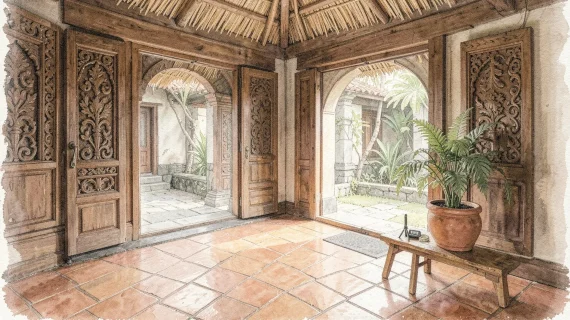
- Villas with entertainment rooms or home theaters. Many Bali villas are built with timber and natural stone. Both materials reflect sound differently from concrete. Entertainment rooms in villas often have long reverberation because hard surfaces dominate. Acoustic treatment has to work around the existing interior character, not compromise it.
- Spas and wellness centers. Quiet is the core product of a spa. Sound leaking in from adjacent rooms, footsteps in corridors, or air conditioning noise reaching a treatment room all damage the guest experience. The goal here is not simply reducing echo inside the room, it is making sure the room is properly isolated from outside disturbance.
- Cafes, lounges, and bars. High ceilings and hard floors are a combination that almost always produces excessive noise. Guests struggle to hold a conversation because sound bounces in every direction. Acoustic treatment in Bali cafes and lounges focuses on reducing reverberation time without dramatically changing the feel of the space.
- Boutique hotels and resorts. The most common complaint from hotel guests is sound coming through from the next room or the corridor. Partition walls and doors are the two most frequent weak points. We handle inter-room isolation, treatment in lounge and dining areas, and meeting rooms.
- Recording studios for local and expatriate musicians. Bali has an active music community, both local musicians and expatriates who have settled there. Recording studios need serious isolation from outside noise and internal treatment so recordings come out clean. This work combines both approaches at once.
How does an acoustics project in Bali work from start to handover?
The process is structured and starts well before the team flies to Bali. That preparation is what makes the on-site work run efficiently.
- Initial consultation by video call. We listen to the acoustic problem you are dealing with, the type of space, and what outcome you want. No firm numbers at this stage, but a clear early picture of the approach that makes sense.
- Client submits room data. You send photos of the existing space from all angles, a floor plan, and the length, width, and height dimensions. This is the data we use to build the initial estimate.
- Cost estimate prepared before departure. The estimate covers materials, installation, and travel costs, each listed separately. You know exactly what every item in the quote is for.
- Survey team flies to Bali. Once the estimate is approved and the schedule confirmed, the team departs. The physical survey is done on site to measure existing building conditions that photos cannot capture.
- Acoustic measurement and treatment design. The team takes acoustic measurements using equipment brought from Pamulang. Those results drive the final treatment design: panel placement, material selection, and installation sequence.
- On-site installation. Work is carried out according to the design approved by the client. You can monitor progress directly.
- Re-measurement before handover. This is a step we treat as mandatory. Measurements are taken again to confirm that the results match the agreed targets. Handover happens only after the numbers meet the standard.
For a more detailed look at our standard workflow, read our guide on the process from survey to handover.
What do travel costs to Bali cover and how are they calculated?
Travel costs are always stated upfront, separate from material and installation costs. We do not fold them into unit material prices, because that only makes a quote look cheaper than it is without being honest about what you are paying for.
Travel cost components for a Bali project include:
- Return flights for all team members sent to the project
- Accommodation for the duration of on-site work
- Shipping or checked baggage costs for materials not available in Bali
- Local transport while in Bali
We cannot publish a fixed number here because it depends on three main factors: how long the project runs, how many team members are needed, and how much material needs to be transported. A single-room project completed in two days will have very different travel costs from a hotel lounge project that takes a week with a larger team.
What we can confirm: every travel cost component is listed in detail in the quote document before you sign the contract. You will not find a charge on the final invoice that was never mentioned. That has been our standard practice for a long time, and we consider it the most basic requirement of a healthy working relationship.
What should a Bali client prepare before the survey team arrives?
Good preparation on the client side directly affects how efficiently the survey runs and how much time the team needs on site. The more complete the data available before the team arrives, the shorter the visit needs to be, and that has a direct effect on overall project cost.
Here is what to prepare before the team comes:
- A floor plan, even a rough hand-drawn sketch. It helps the team understand the layout before they arrive.
- Photos of the existing space from all sides, including the ceiling, floor, and details of doors and windows. Complete photos reduce the number of technical questions that need to be resolved during the survey.
- Room dimensions: length, width, and height. For irregularly shaped rooms, measurements section by section are more useful than a rough overall estimate.
- Your acoustic goal. Do you want to reduce echo inside the room, stop sound from leaving the room, or both? A clear goal determines which approach is used.
- A rough budget range. An exact number is not necessary, but a ballpark figure helps the team design a solution that is actually achievable, not just technically ideal.
- Your availability schedule for the space. Rooms that are actively in use need coordinated scheduling so installation does not disrupt operations.
Clients who come to the consultation with complete data consistently move through the survey and quotation process faster. That is better for everyone involved.
The difference between soundproofing and acoustic treatment, and which one Bali spaces actually need
This question comes up regularly from clients who are approaching acoustic work for the first time. The answer matters, because choosing the wrong approach means spending money on a result that does not solve your problem.
Put simply: acoustic treatment works inside a room to reduce echo and sound reflections. Soundproofing (or sound isolation) works on walls, floors, and ceilings to stop sound from moving between rooms. These are technically different jobs, they use different materials, and they solve different problems.
For spaces in Bali, the right approach depends on the specific problem:
- Villas and spas most often need acoustic treatment to reduce echo rather than full isolation. Timber and natural stone reflect sound, and the right treatment reduces those reflections without touching the interior aesthetic.
- Cafes and lounges typically need both: treatment to reduce internal noise so guests can hold a conversation, and some isolation at specific points if there is an external noise source causing problems.
- Recording studios need serious isolation as well as internal treatment. This is the most complete and most technically demanding type of project.
To understand the difference before your consultation, read our article on the difference between soundproofing and sound isolation. Getting these two concepts clear from the start makes the consultation process significantly more efficient.
Frequently asked questions
Are there extra costs for an acoustics project in Bali compared to Jakarta?
Yes. Travel costs cover return flights, accommodation during the project, and material shipping. Every component is listed separately in the quote before you sign anything, so there are no surprises on the final invoice. The total depends on how long the project runs and how many team members are needed on site.
Does the survey have to happen on site, or can it be done online?
The initial consultation happens by video call. A physical survey is still required before work begins, because wall, floor, ceiling, and structural conditions cannot be assessed from photos alone. That on-site survey determines which materials and installation methods are right for your space.
Can the team from Pamulang handle an acoustics project in Bali?
Yes. Bali is our second primary service area, not an exception. The team travels from Pamulang with measurement equipment and the materials needed for the job. Travel costs are stated upfront before you sign the contract, not buried elsewhere. The process starts with a remote consultation and data submission from the client, so the team arrives in Bali already knowing what the project involves.
How long does on-site work in Bali take?
It depends on the size and type of space. A single room such as a recording studio or small spa treatment room typically takes two to four days on site. Larger projects such as a hotel lounge or a cafe with multiple treatment points can take a week. The exact schedule is confirmed after the survey and initial measurements, because the existing building conditions determine how long installation takes.
How long does the full process take from first consultation to project completion in Bali?
Usually two to four weeks from the first consultation, covering data submission, design and quotation, scheduling the team’s departure, and on-site installation. Projects involving multiple rooms or more complex requirements take longer.
Are acoustic materials brought from Jakarta or sourced locally in Bali?
Most materials come from Jakarta because specific acoustic products have limited availability in Bali. Where standard materials that meet technical specifications are available locally, the team will use them. That decision is made during project planning to keep logistics costs down.
Summary
The distance between Pamulang and Bali is not a barrier when the process is structured and transparent from the start. The consultation runs remotely, a complete estimate including travel costs is in place before the team departs, and measurements are taken again before handover. That is how we work on every project, including those in Bali.
If you are planning an acoustics project in Bali, whether for a villa, cafe, spa, hotel, or studio, the first step is straightforward: tell us about your space. From there, we prepare an estimate before the team flies to Bali. Start your consultation and get a cost estimate here.